
Home Decor Accessories: 2026 Guide to Affordable Accents
Table of Contents
- Why Home Decor Accessories Do the Heavy Lifting in 2026
- Living Room Decor Accessories That Anchor the Space
- Wall Decor That Works With Your Layout, Not Against It
- Bedroom Decor Accessories: Calm, Cozy, and Coordinated
- Affordable Home Decor: What $10 to $30 Actually Buys
- Materials, Durability, and Care for Everyday Pieces
- Common Mistakes That Make Accessories Look Cluttered
- Conclusion: Build Your Home Decor Accessories Collection Slowly
- Frequently Asked Questions
Last Updated: October 6, 2026
Why Home Decor Accessories Do the Heavy Lifting in 2026
Home decor accessories are the small, movable pieces that finish a room: pillows, throws, wall art, vases, mirrors, candles, plants, and the trays and boxes that corral them. They carry a space's personality at a fraction of furniture's cost.
Here is the argument we make to every customer who asks where to start: accessories are not the finishing touch, they are the strategy. According to the American Society of Interior Designers' industry resources, accessories and lighting are consistently among the first elements designers adjust when a room feels flat, because they change the look fastest for the least money.
Below, we break down home decor accessories room by room, with real prices, scale rules, and the mistakes that cause clutter.
Living Room Decor Accessories That Anchor the Space
Decorative pillows are the fastest change in the room. Two or three on a sofa is enough; five looks like a showroom.
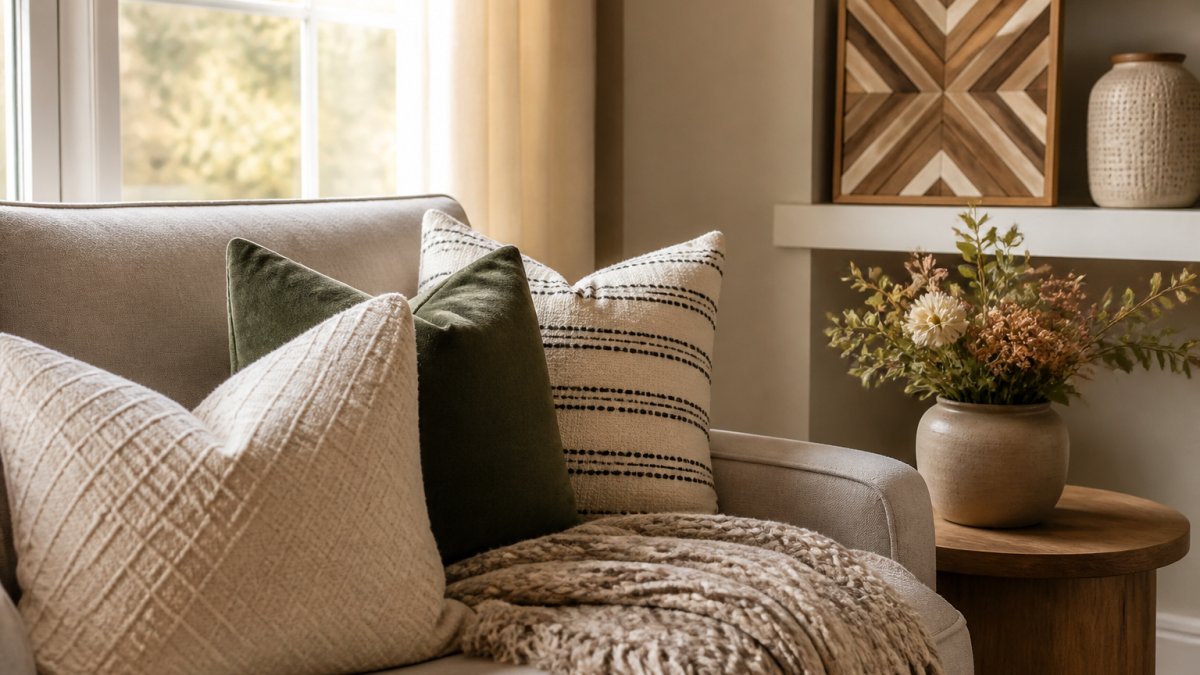
Throws should look dropped, not folded into a perfect square. Drape one over an arm or chair back and leave it.
Vases, decorative trays, and decorative boxes handle the surfaces.
Mirrors do the heavy lifting on light. A mirror opposite a window roughly doubles the daylight in the room.
Decorative Pillows and Throws: The 20-Minute Refresh
Swap the pillow covers and the throw, and the room reads as new, the cheapest significant change in home decor, done in about twenty minutes.
- Fall and winter: deeper tones, heavier textures, one plaid or cable-knit throw
- Spring and summer: lighter neutrals, linen or cotton covers, a lighter throw folded once
- Year-round base: one neutral pillow you never swap, so the room never looks bare between seasons
Wall Decor That Works With Your Layout, Not Against It
Wall decor should follow the furniture, not float above it. Art belongs centered over the piece it relates to, a sofa, bed, or console table.
Wall art groupings work best treated as one shape. Lay the pieces on the floor, arrange them until the outer edges form a rectangle, then hang, ten minutes that saves a wall full of holes.
Picture frames and tapestries fill large walls a single print cannot carry. Clocks work as both function and decor, especially in kitchens and entryways.
Wall decor also includes smaller seasonal pieces that rotate. Our Year-Round Interchangeable Welcome Sign earns its keep: one 12 x 12 inch solid wood sign with 14 interchangeable magnetic icons covers fall, Halloween, Thanksgiving, Christmas, Valentine's Day, Easter, summer, and more, replacing a stack of seasonal signs for $30.

The 3-5-7 Rule and Scale You Can Actually See
The 3-5-7 rule groups accessories in odd numbers, three small objects, five medium, or seven small-to-medium, so the eye has a clear focal point. Odd numbers look more natural because the eye cannot pair them up and move on.
Scale is the part most people miss. On a large coffee table, a single small vase disappears, group it with a stack of books and a bowl, or choose one larger piece instead.
Bedroom Decor Accessories: Calm, Cozy, and Coordinated
Bedroom accessories must look styled and still let you sleep: fewer objects, softer contrast, and a plan for scale. Most unfinished bedrooms are not missing decor, they are missing proportion.
Start with the bed, which sets the scale for everything else. A queen is roughly 60 inches wide and a king roughly 76; accessories should relate to that width rather than float in the middle of the wall.
Plan the room in three zones
Treat the bedroom as three accessory zones, each with one job, the planning step that keeps a bedroom from becoming a pile of small objects.
- Sleep zone (the bed): pillows, shams, one throw. This zone carries the color story.
- Landing zone (nightstands and dresser): one lamp or candle grouping, one small tray, one plant at most. This zone carries function.
- Wall zone (above the bed and above the dresser): one piece or one grouping sized to the furniture below it. This zone carries scale.
If a piece does not belong to one of those three zones, it probably belongs in another room.
Pillow math that actually works
A common pattern is three layers: two sleeping pillows against the headboard, two shams in front, and one accent pillow centered in front. On a queen or king, that reads full without a nightly rebuild.
Sizing matters more than count. Shams are typically 20 x 26 or 26 x 26 inches, and an 18 x 18 inch accent pillow sits comfortably in front of either.
Scale rules for the wall above the bed
Art or a mirror above a bed should span roughly two-thirds to three-quarters of the headboard width. On a 60-inch queen headboard, that means a piece or grouping in the 40 to 45 inch range.
Above a dresser, match the art to the dresser, not the wall, a 60-inch dresser wants a 40 to 45 inch grouping for the same reason.
Color coordination for a calm room
Limit the palette to two or three colors and repeat each at least twice: one dominant neutral (walls, bedding), one mid-tone (curtains, shams, a throw), and one accent in small doses (a candle, a tray, a pillow).
Year-Round Interchangeable Welcome Sign | Magnetic Seasonal Front Door Sign, 14 →
Texture keeps a two-color room from looking flat. Pair a smooth surface with a nubby one, a linen sham against a cable-knit throw, or a glass candle holder against a wood tray, and the eye reads depth even when colors are nearly identical.
Nightstand and dresser surfaces
One grouping per surface, arranged at three heights: a lamp (tall), a small stack of two books or a tray (medium), and a candle or small plant (short). That gives the eye a focal point and keeps the surface usable.
- Pillows: two sleeping pillows, two shams, one accent pillow.
- Throws: one at the foot of the bed, folded in thirds so the fold faces out.
- Candles and candle holders: one grouping on a dresser or nightstand, never near curtains or bedding.
Home fragrance belongs in the bedroom more than any other room, a candle or diffuser does the work of a large decorative piece for less.
Affordable Home Decor: What $10 to $30 Actually Buys
Affordable home decor in the $10 to $30 range covers most of what a room needs, the band where accessories become a small, repeatable upgrade. The trick is splitting a budget across categories instead of buying five versions of the same thing.
A budget breakdown by category
Spend the most on pieces you touch and look at daily, and the least on pieces that rotate with the season. Here is how a $100 accessory budget can break down for one room.
| Category | Suggested share | What it buys | Why it earns the money |
|---|---|---|---|
| Textiles (pillow covers, throw) | $30 to $40 | Two covers and one throw | Highest visual change per dollar, and it is the layer people actually touch |
| Wall piece or grouping | $25 to $35 | One sign, print, or small grouping | Fixes the scale problem on a bare wall |
| Surface decor (tray, vase, candle) | $20 to $25 | One tray plus one object | Turns a scatter of small items into one intentional group |
| Seasonal or rotating piece | $10 to $15 | One interchangeable or holiday item | Keeps the room current without a full re-buy |
That split is a starting point, not a rule. If your walls are covered, move the wall share into textiles; if your surfaces are bare, do the opposite.
What each price point realistically buys
- Under $15: box signs, small wood block signs, candle holders, small trays, pillow covers, expect smaller scale and lighter materials.
- $15 to $25: a throw, mid-size vase, light-up seasonal piece, or two-piece tray set, where a single item can hold a surface on its own.
- $25 to $30: an interchangeable sign system, larger framed piece, quality throw, or grouping of two smaller items, where one purchase can change a whole wall or entryway.
Value comparison: what to check before you buy
Price alone does not tell you whether a piece is a good value. Four checks do most of the work.
- Scale per dollar. A $12 sign too small for the shelf is worse value than a $25 piece that fills it. Measure the surface before you shop.
- Storage cost. Flat-storing pieces (signs, covers, resin figures) cost nothing to keep; bulky seasonal decor costs closet space.
- Battery and refill costs. Check the battery type and how many light-up decor and candles take before you commit.
- Versatility. A piece that works in two rooms or two seasons beats a single-use item at the same price.
Where the $10 to $30 range falls short
Be honest about the ceiling. This band is not where you buy a large mirror, statement floor lamp, or big framed canvas, those are anchor purchases you save for. The $10 to $30 range is for the layers around the anchor, and it is very good at that job.
Here is what we stock in that range, and what each piece is actually for.
| Accessory | Price | Where It Works Best | What It Replaces |
|---|---|---|---|
| Funny kitchen box sign | $10 | Kitchen counter, coffee bar, tiered tray | A blank backsplash corner |
| Funny bathroom box sign | $10 | Guest bath, powder room, toilet tank | Nothing on the walls |
| Wood block signs (4x6) | $12 | Shelves, mantels, entry tables | Seasonal art that gets stored |
| Light-up resin pumpkins | $15 | Table, mantel, porch, shelf | Fresh pumpkins that rot |
| Interchangeable welcome sign | $30 | Front door, porch, entryway | A new sign every season |
Two deserve a note. Our Light-Up "Boo!" Resin Pumpkin and Light-Up "Thankful" Resin Pumpkin run on three included LR44 batteries and measure about 8 by 6.5 inches, large enough to hold a mantel or table alone. And the 4x6 wood block signs, like our Ghost Walking a Ghost Dog and Ghosts by Campfire pieces, stand upright without an easel because the maple frame is thick enough to support itself.


Materials, Durability, and Care for Everyday Pieces
Materials decide how long an accessory looks good, and care decides whether it survives the season, the part that determines whether you rebuy next year.
- Resin: sturdy and easy to wipe clean; our resin pumpkins take a dry cloth and store flat.
- Solid wood and maple: durable, but keep away from direct moisture. Our wood block and box signs wipe clean with a dry cloth and are for indoor use.
- Glass decor: the most fragile category, keep it off high-traffic surfaces and shelf edges.
Curtains and accent rugs collect dust fast and are worth vacuuming on a schedule rather than when they look dirty.
For safety, the U.S. Consumer Product Safety Commission publishes recalls and safety guidance on candles, small decor with button batteries, and other household items worth checking before you place them where children or pets can reach.
Common Mistakes That Make Accessories Look Cluttered
Clutter is almost never about having too much. It is about too many things competing at the same visual weight. Fix the competition and the room reads as styled even with the same number of objects.
The mistakes we see most often:
- Everything is the same size. Five identical objects in a row read as a collection, not a display. Vary height by at least a third between tallest and shortest.
- No negative space. Empty space is what makes the styled parts look deliberate.
- Too many focal points. One statement piece per surface, if the mantel has a sign, vase, candle, and clock all demanding attention, none win.
- Color without a plan. Pick two or three colors and repeat them across the room; random accents make a room feel busy.
- Ignoring how the room is used. A tray on an ottoman used as a footrest will be on the floor by week two.
- Buying for the season only. Seasonal decor that cannot store flat becomes a problem by January.
Conclusion: Build Your Home Decor Accessories Collection Slowly
The pressure to finish a room in one weekend produces cluttered shelves and drawers full of pieces you never use again.
That is how we stock at Three C'S Mama Boutique & Gifts: handpicked pieces from small makers, priced so you can add one thing at a time.
Subscribe to our emails and we will let you know when new pieces land, including the seasonal drops that sell through fastest.
Frequently Asked Questions
What are the top 10 home decor items every room needs?
The essentials that work in almost any space: decorative pillows, a throw blanket, wall art or a wood block sign, a mirror, a vase or two, candles or a candle holder, a table lamp, an accent rug, picture frames, and a decorative tray. These pieces cover seating, walls, surfaces, and lighting. You do not need all ten at once. Start with three that fill the emptiest zones in your room, then add one or two per season so the space evolves without a full redecorating budget.
What is the 3-5-7 rule of decorating?
The 3-5-7 rule is a styling guideline for arranging accessories in odd-numbered groups: three items on a small surface like a nightstand, five on a medium surface like a console table, and seven on a large surface like a bookshelf or mantel. Odd numbers create visual movement because the eye cannot pair them into symmetrical halves. Vary height and texture within each group. A tall vase, a medium sign, and a small candle holder in a set of three reads more interesting than three identical objects lined up.
How do you accessorize a living room without it looking cluttered?
Pick one focal point per surface. On a coffee table, try a tray with a candle and a small vase, then leave the rest of the tabletop empty. On shelves, group items in threes and leave one shelf mostly bare. Stick to two or three colors across your living room decor accessories so pieces feel related. Add texture through materials like wood, glass, and fabric rather than adding more objects. If a surface has not been touched in a month, that item is decoration you can rotate out.
What affordable home decor accessories make good gifts?
Freestanding wood block signs, light-up seasonal pieces, and funny box signs all work well because they are useful, easy to wrap, and do not require the recipient to commit to a style overhaul. A Halloween wood block sign at $12 or a light-up resin pumpkin at $15 suits a hostess, teacher, or friend who decorates for the seasons. For housewarmings, an interchangeable welcome sign at $30 covers every holiday with one purchase, which is a practical gift for someone in a new home.
How can I make a room look more put together with accessories?
Repeat one or two colors in at least three places. If your throw has rust tones, carry that into a candle holder or a small vase nearby. Vary height on every surface: one tall piece, one medium, one short. Hang wall decor so the center sits at eye level, roughly 57 to 60 inches from the floor, and keep art about 8 to 10 inches above furniture. These three moves, color repetition, height variation, and correct placement, do more for a room than buying more items.